Introduction to AI in Stock Market Predictions
The stock market has been a very dynamic environment in which investors make an attempt to make a profitable decision. Historically, market forecasting was based on financial conclusions, trend, and professional knowledge. But with the emergence of artificial intelligence (AI), the prediction process has been transformed.
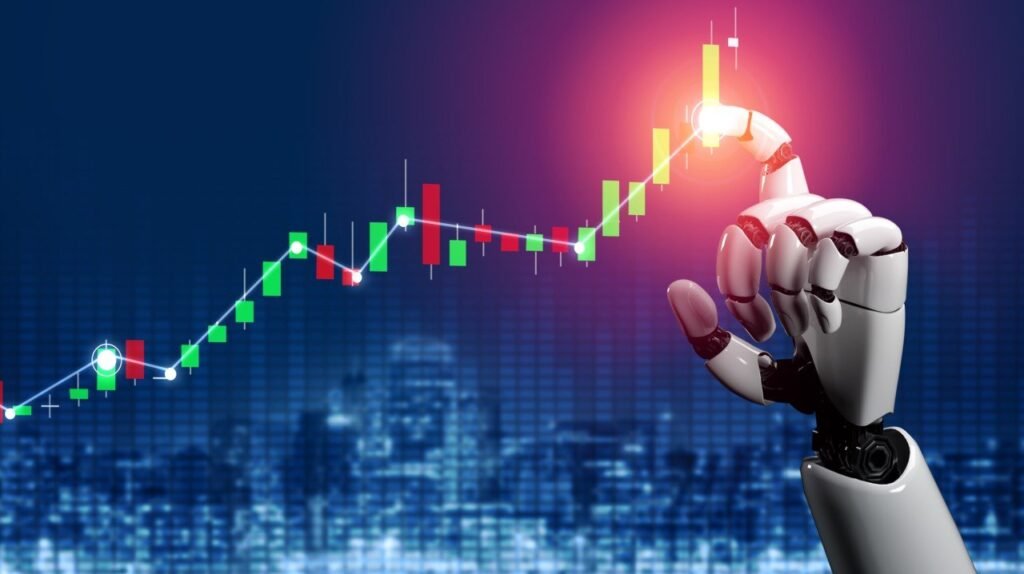
The stock market predictions based on AI utilize high-complexity algorithms and machine learning models to process large volumes of data and identify patterns that cannot be easily identified by human analysts. With the use of AI, investors and institutions will be able to make better decisions, minimize risks, and, possibly, receive better returns.
The Artificial Intelligence Stock Market Prognostication
There are a number of methods that AI employs to predict the actions in the market. One such approach is the use of machine learning models like neural networks, support vector machines and decision trees. These models are trained with historical data, and it can be stock prices, trading volumes, economic indicators, sentiment of social media and even news headlines.
Deep learning is also a branch of machine learning and has been shown to be efficient in predicting the stock market. Sequential data can also be analyzed by neural networks, and recurrent neural networks (RNNs) and long short-term memory (LSTM) models can be useful when it comes to predictions in time series. These models are very effective in identifying trends over a long period and are also able to predict the price trend based on previous performance. In addition, deep learning models are capable of working with unstructured data, e.g., financial news or social media posts, and this information is frequently ignored by the traditional models.
Use of Big Data in AI Predictions
The capability of AI to process massive amounts of data is one of the reasons why it has become effective in the prediction of the stock market. The current stock market is producing an avalanche of information at an unprecedented rate, in price quotes and trading volume as well as economic indicators and events around the globe. The old approaches to data analytics are not efficient in handling this amount of data, whereas AI is effective in these conditions.
Big data enables the AI models to process structured data, like stock prices in the past, and unstructured data, like social media posts or news articles. Through the processing of these various datasets, AI will be able to discover trends and patterns that could reflect on potential opportunities of investments or threats. Such ability is especially useful in cases of high-frequency trading when the decisions have to be taken in milliseconds, and any latency may lead to the loss of profits.
Additionally, AI can keep on updating its predictions with each new piece of information. This flexibility means that the investors are continually operating with the latest information which enhances the accuracy of the forecasts and the speed at which the changes in the market can be responded to.
The advantages of AI-Based Stock Predictions
There are several advantages of artificial intelligence over traditional methods of predicting the stock market. First of all, AI works significantly faster than a human being to process and analyze information, which makes it possible to make fast decisions. Such speed is crucial in the risky markets where time can be a crucial factor since profits can be impacted significantly. Secondly, AI will be capable of detecting patterns and linkages that are too complex to be noticed by human analysts. AI can generate insights that would advance investment strategies by defining the presence of minute correlations.

The other advantage is consistency. Human analysts are likely to be emotional or engage in cognitive biases or to be exhausted leading to disproportional forecasting. Quite the contrary, AI models are objective and data-driven, decreasing subject errors. Moreover, using the help of the historical and recent data, AI will be able to recreate a number of different situations, and it will enable investors to estimate risks and potential returns better.
Challenges and Limitations
Despite this, there are challenges associated with AI-based stock market prediction. The greatest limitation is the fact that financial markets cannot be predicted. Stock prices are influenced by a lot of factors since they include geopolitical events, alterations in regulations and even abrupt changes in market sentiment. However, despite being able to detect trends, AI is not very good at the prediction of the unexpected.
Another problem is data quality and reliability. The data on which AI models are fed only constrains the quality of the models. In addition, machine learning can also overfit since a model can appear to be operating with previous data but fail to forecast what is going to occur in the future in the market. This risk is associated with a proximate model selection, testing, and validation.
Real-World Applications
The stock market already has hedge funds, investment banks, and trading platforms that retail clients can use to implement AI-based predictions. Hedge funds use AI algorithms for identifying lucrative trades, risk management, and optimization of the portfolio. AI is employed by investment banks to roboticize their trading activities as well as detect market anomalies. Retail platforms offer AI-based functionalities, which have the potential to offer users insights, predictions, and suggestions according to the live market analysis.
Another field of applicability of AI to portfolio management is ensuring a balance between risk and returns through modulating the holdings in the portfolio, depending on the predictive information.
Stock Market Prediction in AI
Artificial intelligence in the stock market prediction has a bright future. As computing capabilities in the future increase and more data is available, AI models will be even more accurate and sophisticated. Predictive capabilities can also be enhanced further by tying up with other emerging technologies, such as quantum computing, which will give the capability to process even larger datasets in a significantly less amount of time.
Finally, AI can bring more advanced financial data to democracy. In the recent past, sophisticated prediction models were available to institutional investors. The individual investors can use the same capabilities as the AI tools open up to everyone and balance the playing field, raising the financial literacy of the individual.
Conclusion
Financial technology has seen the significant use of AI in predicting the stock market. Having machine learning, deep learning, and natural language processing, AI systems can go through huge datasets that are non-homogenous and find trends that are otherwise not observed by human analysts. Some of the advantages of it include the fact that it stands to make decisions at a faster rate, it is more accurate, it is consistent and it is tailored to the specific needs of the investments. However, the problem of quality of data, uncertainty in the market, and regulatory restrictions ought to be managed.

Even though AI is not a crystal ball that is able to assure profitability, the technology can be an immensely powerful instrument that can be used to enhance investment strategies and risk management. As the technological change keeps progressing, there is a likelihood of more and more AI application into the stock market because it will offer investors more intelligent, quicker and better-informed ways of addressing the complexity of the financial market. AI is the entry point to more informed and likely more profitable investments for the people who are willing to adopt and learn these tools.